Everyday Worlds of the North
In Old Norse, the masculine noun víkingr referred to an activity—going out on a piratical or trading raid overseas—not an ethnic label for every Scandinavian farmer, smith, child, and weaver. At home in Norway, Denmark, Sweden, and the North Atlantic settlements, more than ninety percent of the population lived inside rural agricultural households governed by seasonal livestock herding, textile production, and public legal assemblies.
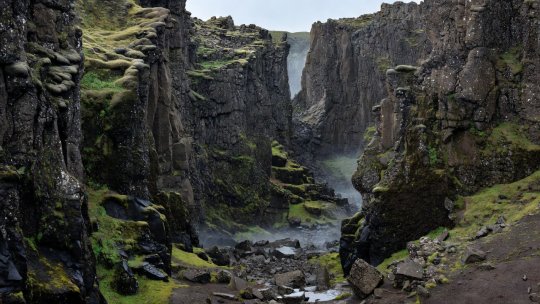
The Þing: Law Without a Police Force
Scandinavian communities resolved homicide feuds, boundary disputes, debt defaults, and marriage contracts at open-air assemblies called þing (such as the Alþingi established at Þingvellir in Iceland around 930 CE, the Gulating and Frostating in Norway, and Thingwall sites across the British Isles). Each summer at Þingvellir, the elected lawspeaker (lögsögumaður) recited one-third of the oral law code from memory at the Law Rock (Lögberg).
Because Viking Age Iceland had no king, standing army, or sheriff, court verdicts were enforced privately by the winning litigant's coalition of chieftains (goðar) and supporters. Sentences ranged from monetary silver/cloth fines (wergild) to lesser outlawry (three years' banishment abroad, fjörbaugsgarðr) and full outlawry (skóggangr, "forest-going"), which stripped the offender of all legal protection and property.
Social Stratification: Jarls, Bœndr, and Þrælar
The Eddic poem Rígsþula offers a mythic etiology for three social tiers fathered by the god Heimdallr (calling himself Rígr): unfree thralls (þrælar), free landholding farmers and artisans (karlar or bœndr), and the warrior aristocracy (jarlar). While Rígsþula is a schematic literary poem, archaeological graves and medieval laws confirm that Viking Age society was steeply hierarchical—and heavily reliant on coerced labor.
Thralls were captured in raids across Ireland, Britain, the Slavic Baltic, and rival Scandinavian districts, or born into servitude and debt bondage. Isotopic and dietary analysis of double burials at sites like Flakstad in Lofoten shows that subsidiary skeletons interred headless or bound beside an elite main burial frequently consumed a marine-heavy, lower-tier diet distinct from the terrestrial meat and grain diet of their masters.
Homespun Currency: Vaðmál and Sailcloth
In medieval Iceland and western Norway, standardized homespun woollen twill cloth—vaðmál—was not just clothing; it served alongside weighed silver as legal currency. Taxes, bridewealth, and manslaughter fines were regularly calculated in ells (álnir) of two-ell-wide woollen fabric woven on vertical warp-weighted looms.
Because women controlled every stage of textile manufacturing inside the longhouse—from plucking sheep wool (rúning) and spinning with soapstone whorls to beating weft threads tightly against the weather—female labor directly underpinned both maritime mobility (sails) and legal exchange.
Proto-Towns: Hedeby, Birka, Kaupang, and Jorvik
While most Scandinavians lived on dispersed farmsteads, the eighth and ninth centuries saw the rise of planned seasonal and permanent trading towns (kaupangar) protected by semicircular earthen ramparts and harbor palisades:
- Hedeby (Haithabu), Schleswig-Holstein Positioned at the narrow base of the Jutland peninsula, allowing merchants to portage cargoes between the North Sea and the Baltic without sailing around stormy Skagen. Excavations yielded Rhenish glass, Eifel basalt millstones, walnuts, and its own early ninth-century silver coinage.
- Birka (Björkö, Lake Mälaren, Sweden) Flourished c. 750–975 CE with over 3,000 graves, intensive bronze-casting and comb-making workshops, and rich eastern trade links bringing Chinese silk, carnelian beads from Gujarat, and Abbasid dirhams.
- Kaupang (Skiringssal, Vestfold, Norway) Mentioned in Ohthere of Hålogaland's late ninth-century travel account to King Alfred of Wessex; specialized in exporting Norwegian soapstone vessels, whetstones from Eidsborg, walrus ivory, and furs.
Reference Guide to Major Viking Age Archaeological Sites
| Site & Modern Location | Peak Activity Period | Primary Site Function | Diagnostic Archaeological Evidence |
|---|---|---|---|
| Birka & Hovgården (Sweden) | c. 750–975 CE | Mercantile emporium & royal manor | Chamber graves, garrison hall, Arabic dirhams, glass beakers, bronze casting molds. |
| Hedeby / Haithabu (Germany) | c. 770–1066 CE | International portage hub & mint | Harbor jetty timbers, Hedeby 1 warship wreck, runestones (DR 1–DR 4), coin dies. |
| Gamla Uppsala (Sweden) | c. 550–1100 CE | Royal mounds, cult hall & later cathedral | Monumental 50-metre timber hall post-holes, Vendel/Viking cremation mounds. |
| Jelling (Denmark) | c. 950–985 CE | Royal dynastic monument complex | Two massive mounds, 356-metre stone ship setting, 1.4-km palisade, Runestones DR 41 & DR 42. |
| Jorvik / Coppergate (York, UK) | 866–1066 CE | Anglo-Scandinavian urban craft capital | Waterlogged timber workshops, Coppergate silk cap, coin dies, iron tools, amber rings. |