Inside the Saga Tradition
The Old Norse noun saga (plural sögur) comes from the verb segja ("to say" or "to tell"). It refers to any extended narrative told in prose—ranging from sober twelfth-century chronicles of Norwegian monarchs to fantastical fourteenth-century tales of dragon-slayers and cursed swords. Knowing which sub-genre a saga belongs to is the single fastest way to judge how much historical weight its claims can bear.
1. Kings' Sagas
Chronicling the rulers of Norway and Denmark from mythical origins down to the late twelfth century. The flagship work is Snorri Sturluson's Heimskringla (c. 1230), alongside earlier compilations like Fagrskinna and Morkinskinna.
Evidentiary status: In his famous prologue, Snorri explicitly states his historical method: he trusts contemporary skaldic verses recited directly in front of the kings or their sons because open fabrication in court would have been mocked as "scorn, not praise" (háð, en eigi lof).
2. Sagas of Icelanders
Roughly forty anonymous prose narratives—including Egils saga, Laxdæla saga, Eyrbyggja saga, and Brennu-Njáls saga—set during the Saga Age (söguöld, c. 870–1030 CE), covering the settlement of Iceland and the generation after conversion to Christianity.
Evidentiary status: Written in the thirteenth and early fourteenth centuries, they preserve remarkably accurate local geography, farmstead names, and social norms, while shaping dialogue and character arcs through high literary craft.
3. Legendary Sagas
"Sagas of Ancient Times" set on the Scandinavian continent prior to the settlement of Iceland (before 870 CE). Famous examples include Völsunga saga, Hervarar saga ok Heiðreks, and Ragnars saga loðbrókar.
Evidentiary status: Rich in heroic poetry, talking birds, cursed blades like Tyrfingr, and mythic genealogy. While they sometimes echo real Migration Period names (like the Gothic king Ermanaric or Attila the Hun), their plots are heroic romance, not ninth-century history.
Case Study: The Two Vinland Sagas Compared
Two separate Icelandic texts preserve memories of Norse voyages southwest from Greenland around the year 1000 CE: Grænlendinga saga (preserved in the late fourteenth-century Flateyjarbók) and Eiríks saga rauða (preserved in Hauksbók, c. 1306–1308, and Skálholtsbók). Comparing them reveals how oral streams diverge while retaining a shared historical kernel:
Grænlendinga saga
Credits merchant Bjarni Herjólfsson with first sighting wooded coasts after being blown off course, followed by four separate expeditions led by Leifr Eiríksson, Þorvaldr, Þorfinnr Karlsefni, and Freydís.
Eiríks saga rauða
Merges the voyages, eliminates Bjarni's sighting so Leifr discovers Vínland on his way back from King Óláfr Tryggvason's court in Norway, and elevates Karlsefni and Guðríðr Þorbjarnardóttir (ancestors of Bishop Haukr).
Despite these narrative differences, both texts describe naming three distinct coastal zones—Helluland (Baffin Island), Markland (Labrador), and Vínland—and encountering Indigenous inhabitants (whom the Norse called Skrælingar). In 1960, Anne Stine and Helge Ingstad excavated eight sod-walled structures, iron boat rivets, a bronze cloak-pin, and a soapstone spindle whorl at L'Anse aux Meadows on the northern tip of Newfoundland. Subsequent high-precision radiocarbon analysis of cosmic-ray event 993 CE in wooden artifacts cut with metal axes confirmed Norse timber working at the site in exactly 1021 CE.
The Material Economics of Calfskin
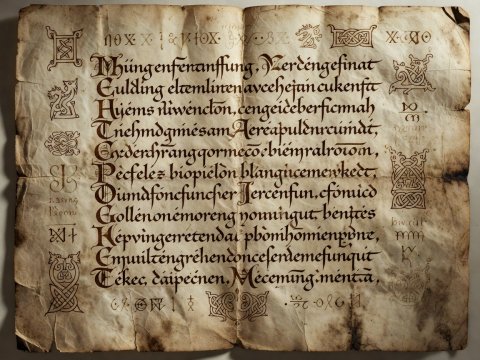
Producing a major medieval Icelandic manuscript required enormous agricultural investment. The monumental compilation Flateyjarbók (GKS 1005 fol, written 1387–1394) consists of 225 huge vellum folios—requiring the prepared skins of more than 110 calves, alongside oak-gall or bearberry ink and imported pigments.
Wealthy Icelandic chieftains and monasteries such as Þingeyrar and Helgafell sponsored these codices not as casual bedtime reading, but as prestige archives legitimizing family land rights and legal lineages during the turbulent Sturlung Era (1220–1262 CE) and subsequent Norwegian royal rule.
Key Surviving Saga Manuscripts and Shelfmarks
When historians cite a saga, they trace its transmission back to specific surviving manuscripts housed primarily in the Árni Magnússon Institute for Icelandic Studies in Reykjavík and the Arnamagnæan Collection in Copenhagen. Below are five foundational codices that anchor our knowledge of Old Norse literature:
| Manuscript Name & Shelfmark | Approximate Date | Key Texts Preserved | Significance for Evidence Weighing |
|---|---|---|---|
| Codex Regius (GKS 2365 4to) | c. 1270 CE | 29 Eddic poems (Völuspá, Hávamál, heroic lays of Sigurðr) | Single surviving witness for the majority of mythological and heroic Eddic poetry. |
| Möðruvallabók (AM 132 fol) | c. 1330–1370 CE | 11 major Sagas of Icelanders (including Njáls saga, Egils saga, Laxdæla saga) | The most comprehensive single medieval anthology of family sagas. |
| Codex Upsaliensis (DG 11) | c. 1300–1325 CE | Snorri Sturluson's Prose Edda, Skáldatal | Oldest complete manuscript of the Prose Edda; explicitly names Snorri as compiler. |
| Hauksbók (AM 371 4to, AM 544 4to, AM 675 4to) | c. 1302–1310 CE | Landnámabók, Eiríks saga rauða, Völuspá (variant) | Partially written in the known hand of lawspeaker Haukr Erlendsson (d. 1334), giving a rare firm date. |
| Flateyjarbók (GKS 1005 fol) | 1387–1394 CE | Extended sagas of Óláfr Tryggvason & Óláfr Haraldsson, Grænlendinga saga | Largest surviving medieval Icelandic book; preserves unique texts embedded as þættir (short tales). |