Meet the Mythic Cast
When we speak of "Norse mythology," we are usually looking through an Icelandic lens ground in the thirteenth century. Our two primary textual pillars—the anonymous poems of the Poetic Edda (mostly preserved in the c. 1270 Codex Regius) and Snorri Sturluson's Prose Edda (written c. 1220 as a mythographic textbook for skaldic poets)—present a cohesive cosmos from creation in Ginnungagap to destruction at Ragnarök. Yet when we compare those pages against Viking Age amulets, place names (toponyms), and carved stones across Denmark, Norway, and Sweden, a fascinating discrepancy emerges between literary spotlight and lived devotion.
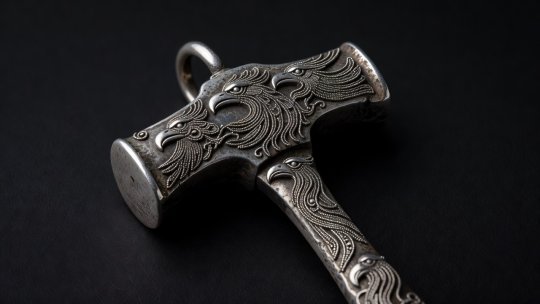
Þórr (Thor): The People's Warder
In both the material record and the literary record, Þórr commands massive presence, though his tone differs across genres. Snorri and comic poems like Þrymskviða sometimes portray him as hot-tempered and straightforward alongside cunning Óðinn. However, the archaeological and epigraphic evidence shows that ordinary Scandinavians trusted Þórr with their daily survival, crops, weather, and safe passage into death.
More than a thousand miniature Mjölnir pendants in iron, bronze, amber, and silver have been excavated from graves and hoards between the ninth and eleventh centuries—frequently worn by women and buried in cremation urns. Furthermore, tenth-century runestones in Denmark and Sweden—such as the Glavendrup stone (DR 209) on Funen and the Virring stone (DR 110) in Jutland—explicitly invoke him with the formula: Þórr vígi þessi rúnar ("May Thor hallow these runes").
Óðinn (Odin): Sovereign of Poets and Earls
In Grímnismál, Hávamál, and Völuspá, Óðinn dominates the cosmology as the one-eyed seeker of wisdom who hung on the world-tree Yggdrasill for nine nights and gathers fallen warriors (einherjar) into Valhöll. Why does he occupy center stage in surviving manuscripts while leaving fewer rural agricultural place names than Þórr or Freyr?
Because our surviving texts were composed and transmitted by aristocratic poets (skáld) and chieftains—the exact social stratum that claimed Óðinn as patron of poetry (the mead of Suttungr) and ecstatic war-band leadership. Materially, small cast copper-alloy and silver figurines with a single eye or flanked by two horned birds—such as the seventh-century horned figures from Uppåkra and Tissø, and the tiny tenth-century enthroned silver figure from Lejre—clusters heavily around royal and aristocratic hall complexes.
Literary Portrait
Wanderer in a dark cloak, master of seiðr divination and runic lore, anxious strategist preparing for the wolf Fenrir at Ragnarök.
Toponymic Footprint
Concentrated at central cult and assembly hubs such as Odense (Óðinsvé, "Odin's sanctuary") in Denmark and Onsala in Halland.
Freyja, Freyr, and Njörðr: The Vanir in the Landscape
Mythological poems describe a primeval war and truce between two divine clans: the Æsir and the Vanir, after which the fertility deities Njörðr, Freyr, and Freyja came to dwell in Ásgarðr. While Victorian retellings sanitized the Vanir into gentle nature spirits, Scandinavian place-name linguistics (onomastics) reveals that their cults were deeply embedded in the fertile soils and maritime trade harbors of Sweden and Norway.
Hundreds of farms and parishes bearing names like Frövi, Fröslunda, Ullevi (linking to the hunting/oath god Ullr), and Njärdavi dot the Lake Mälaren valley and Östergötland. At Rällinge in Södermanland, a tenth-century bronze ithyphallic statuette seated with a conical cap and stroking his beard aligns closely with Adam of Bremen's eleventh-century description of the idol of Fricco (Freyr) inside the temple at Gamla Uppsala.
Meanwhile, small silver female pendants wearing elaborate beaded necklaces (recalling Freyja's prized torque Brísingamen) and gilded figurines from Revninge and Tissø suggest aristocratic female ritual specialists (völvur) actively invoked Freyja's link to seiðr magic and afterlife halls (Fólkvangr).
Loki: Blood-Brother and Catalyst
Unlike Þórr, Freyr, or Óðinn, Loki has zero confirmed Viking Age cult sites and zero theophoric place names across Scandinavia. No farmer sacrificed to Loki for a good harvest. Instead, Loki functions inside the mythos as the indispensable narrative engine: the oath-brother of Óðinn (Lokasenna stanza 9) who both procures the gods' greatest treasures—including Mjölnir, Draupnir, and the walls of Ásgarðr—and engineers their ultimate tragedy through the death of Baldr.
That Loki was known in the Viking Age—and not invented by Christian scribes—is proven by tenth-century skaldic verse (Þjóðólfr of Hvinir's Haustlöng, c. 900 CE) and the tenth-century Snaptun hearth-stone found on a Danish beach, which depicts a mustachioed face with stitched-shut lips matching Snorri's tale of the dwarf Brokkr sewing Loki's mouth closed.
Nine Worlds: Systematic Map or Poetic Shorthand?
Modern posters frequently draw the Norse cosmos as a neat three-tiered subway diagram with nine symmetrical spheres hanging like ornaments on the ash tree Yggdrasill. Yet if you read the primary sources closely, no Eddic poem ever lists all nine worlds in a single canonical roster. In Völuspá stanza 2, the seeress remembers "nine worlds, nine giant-realms" (níu man ek heima, níu íviðjur), while Vafþrúðnismál stanza 43 mentions having travelled through nine worlds down to Niflhel.
Because nine was the quintessential ritual multiplier in Germanic culture—Óðinn hangs nine nights, Heimdallr is born of nine mothers, Draupnir drips eight new rings every ninth night, and the great sacrifice at Uppsala occurred every nine years—poets used "nine worlds" as an evocative totality meaning "every realm of existence." Snorri Sturluson later attempted to organize these realms geographically for thirteenth-century readers, producing a literary synthesis that remains thrilling to read so long as we recognize his editorial hand.
| Deity / Figure | Primary Eddic / Skaldic Sources | Archaeological & Epigraphic Footprint | Place-Name (Toponym) Distribution |
|---|---|---|---|
| Þórr (Thor) | Hymiskviða, Þrymskviða, Þórsdrápa, Gylfaginning | 1,000+ Mjölnir pendants; Altuna & Gosforth stones; runic hallowing formulas (DR 209) | Widespread across Norway, Sweden, Denmark, and Iceland (e.g., Torslunda, Þórsmörk) |
| Óðinn (Odin) | Hávamál, Grímnismál, Völuspá, Ynglinga saga | One-eyed figures (Uppåkra, Lejre); 6th–8th c. helmet press-blech plates (Vendel, Valsgärde) | Moderate; clustered near elite sanctuaries (Odense, Onsala, Odensvi) |
| Freyr & Freyja | Skírnismál, Hyndluljóð, Ynglinga saga | Rällinge bronze statuette; gold foil couples (guldgubbar); necklace-wearing silver amulets | Extremely dense in agricultural central Sweden and coastal Norway (Frövi, Fröjel) |
| Loki | Lokasenna, Haustlöng (c. 900 CE), Gylfaginning | Snaptun forge-stone (stitched lips, c. 1000 CE); possible bound figure on Gosforth Cross | None attested; purely mythic narrative figure rather than object of public cult |
| Ullr & Týr | Grímnismál st. 42, Lokasenna st. 38 | 5th c. Kylver stone & bracteates invoking Tiwaz rune; Lilla Ullevi outdoor cult platform | Týr strong in Denmark (Tisvilde, Tirslund); Ullr dense in Sweden & eastern Norway (Ullevi) |